
You're not only buying a business.
You're deciding what the evidence supports before you price it.
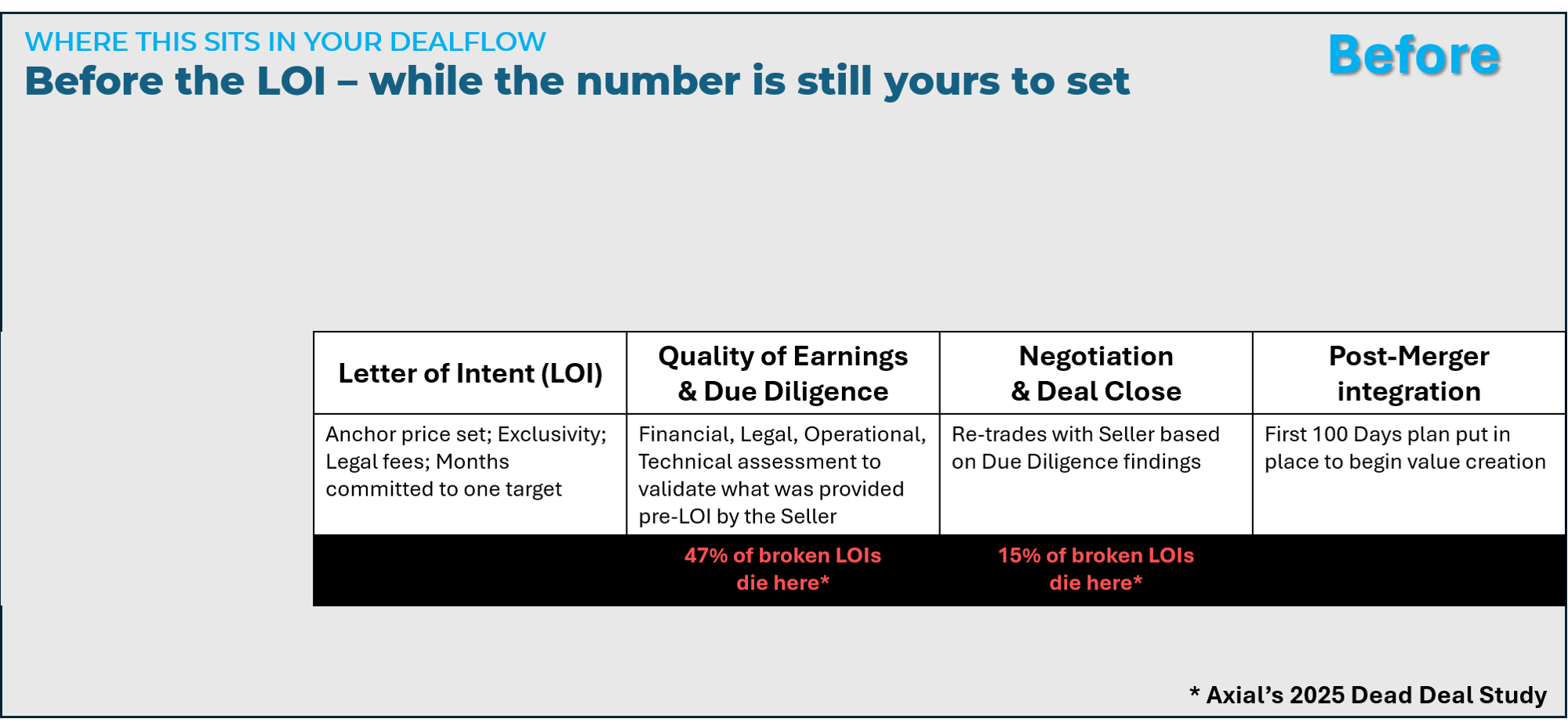
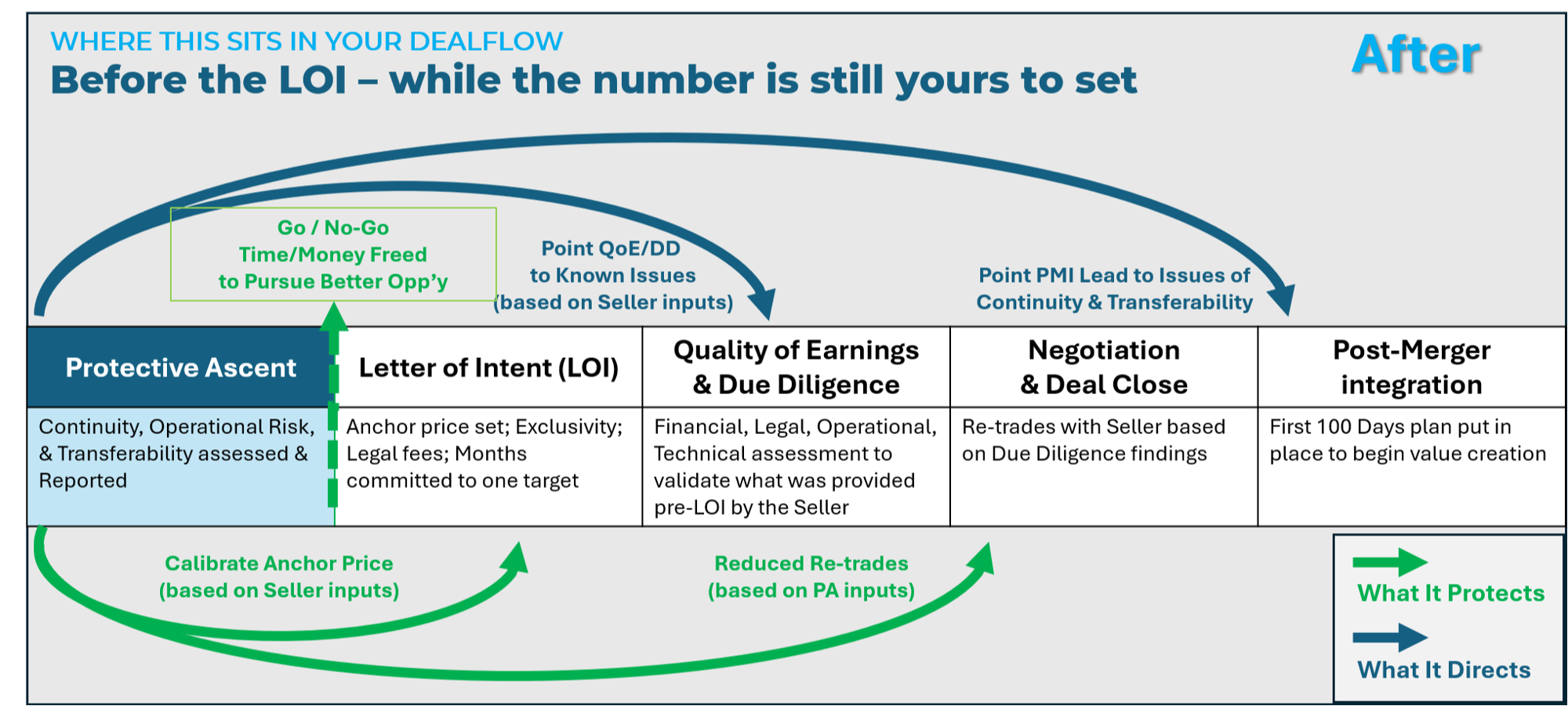
Protective Ascent is a Buyer-side assessment of continuity and transferability before the LOI. It tests what appears capable of transferring, what still depends on the Seller, and what deserves another look before the Buyer relies on it.
BUILT FOR
When the story starts to depend on people
The CIM looks good. The Seller knows the customers. The team knows what to do. Work gets out the door. That said, somewhere in the story, you start noticing how much of that performance depends on particular people.
The Seller owns the important customer relationships. One employee seems to know everything about a critical part of the operation. Decisions that looked like process turn out to be judgment calls. Growth has come from people working harder, with little evidence that the operation itself can carry more.
At some point, you—or your investors—start asking whether you're looking at healthy operations or a collection of heroes and hard workers holding everything together.
That's the question Protective Ascent is built to test:
What continues when the Seller leaves?
Typical targets: $1M-$25M revenue. Up to $50M, depending on the access the sale process allows.
Know what transfers before you inherit it.
If something about a target has you wondering how much of the business actually transfers, start there.
Protective Ascent is designed for established businesses where the operating model can be meaningfully assessed before ownership changes. It is not intended to substitute for financial, legal, tax, cybersecurity, market, environmental, valuation, or other specialized diligence.
If something about a target has you wondering how much of the business actually transfers, start here.
Built to answer a different question
Protective Ascent addresses a different question than post-LOI diligence:
What appears capable of continuing when ownership changes?
Quality of Earnings, valuation, and financial, legal, tax, technical, commercial, cybersecurity, market, environmental, and other specialized diligence remain with the Buyer and its advisors.
Protective Ascent stays focused on continuity and transferability—what appears supported, what still depends on the Seller or others, and what deserves further attention if the Buyer proceeds.
Before the LOI, while the assumptions are still yours to test
IOI → PROTECTIVE ASCENT → LOI → DILIGENCE → CLOSE
Protective Ascent puts continuity and transferability on the table before you've named a price. If something doesn't hold up, you know what deserves another look before you proceed.
How Protective Ascent Works →
What continues when the Seller leaves?
Good current performance doesn't answer that question.
A customer can be loyal to the Seller rather than the company. A key employee can hold capability no one else can readily replace. A profitable business can already be at capacity for the growth the Buyer intends to pursue.
None of those, by themselves, makes it a bad acquisition. They do, however, change what the Buyer may actually be purchasing.
What Protective Ascent Tests →
What these Findings can look like...
Customer and vendor relationships belong to the Seller, not the business
Important relationships may reset - or fail to transfer - when ownership changes, affecting customer continuity or the terms and support the business receives from vendors.
RELATIONSHIP EXPOSURE · ½X-1X TURN
Key staff are loyal to the Seller, not the business
A single-point-of-failure employee can put critical knowledge or capability at risk. Broader churn can affect capacity, quality, reputation, and continuity while replacements are recruited and brought up to speed.
PEOPLE EXPOSURE · ¼X-1X TURN
The business is at capacity, with no systems to scale
The Buyer's growth thesis may require additional people, systems, tools, equipment, facilities, or infrastructure before the intended playbook can produce the expected growth.
CAPACITY / SCALE EXPOSURE · >1X TURN
Two findings in the same category may carry materially different exposure. Where exposures compound, Protective Ascent expressly identifies the interaction; it does not calculate a combined multiplier.
Turn-equivalent exposure describes operating exposure magnitude. It is not a prescribed adjustment to valuation, price, EBITDA, earnings, or consideration.
Why Transferability Matters →
What the Buyer receives
Protective Ascent starts with the Seller's PRE S.C.O.R.E. assessment. The Hot Seat then tests the operating assumptions behind those answers.After that conversation, the Seller answers the same questions again, this time from a different perspective:
If the business transferred to a Buyer today, would this still be true?
The PRE-to-POST movement matters.
- What stayed the same?
- What became more specific?
- What changed?
- What still needs corroboration?
From there, facilitator analysis produces four Buyer-facing outputs:
Operational Continuity Report
What appears positioned to continue after ownership changes - and where continuity is exposed.
Counterparty (Seller) Profile
How the Seller thinks about and leads the business, its relationships, and operations - and how that impacts leadership changes.
Continuity Risk Register
The continuity and transferability exposures identified through the assessment, prioritized for Buyer attention.
Knowledge Transfer Priorities
Where important knowledge or operating capability remains concentrated and requires a credible transfer path.
The assessment concludes with a 1:1 Buyer Debrief to review the findings, provide context, and discuss possible areas for further post-LOI diligence if the Buyer proceeds.
See the assessment process →1
Built on S.C.O.R.E.
Protective Ascent applies the S.C.O.R.E. framework to a specific acquisition question: what continues when ownership changes?
Explore the S.C.O.R.E. Methodology →
Built on 20+ years of integration, transformation, and operating analysis across 14 industries.
Know what Transfers before you Acquire it.
Protective Ascent does not replace Quality of Earnings, valuation, or financial, legal, tax, technical, commercial, cybersecurity, market, environmental, or full operational diligence.
It identifies continuity and transferability findings and, where supported, characterizes operating exposure. The Buyer and its advisors determine what those findings mean for the transaction.
If you're evaluating a lower-middle-market business before the LOI, let's discuss the target.
Go deeper with Built on Sand newsletter →
Evaluate a Target You're Pursuing