
You're not just considering buying a business.
You're setting the price you'd pay for it.
Two businesses at the same asking price can merit very different numbers: one a well-equipped Toyota, the other a base Lexus. The CIM won't tell you which you're looking at. How well the business stands without its seller will.
Protective Ascent is a pre-LOI, buyer-side assessment of continuity and transferability for lower-middle-market acquisitions. It establishes a pricing baseline before you make an offer.
- Complements Quality of Earnings and due diligence. Replaces neither.
- Leads with the question those workstreams aren't designed to ask: does the business run on its own, or on its owner?
It's built for businesses where the owner is still the de facto executive layer, whatever the org chart says. Typical targets have $1M–$25M in revenue; targets up to $50M depend on the access the sale process allows.
"One deal, a bad surprise is a bad quarter. If it's the fifth deal this year, it's a pattern in the portfolio."
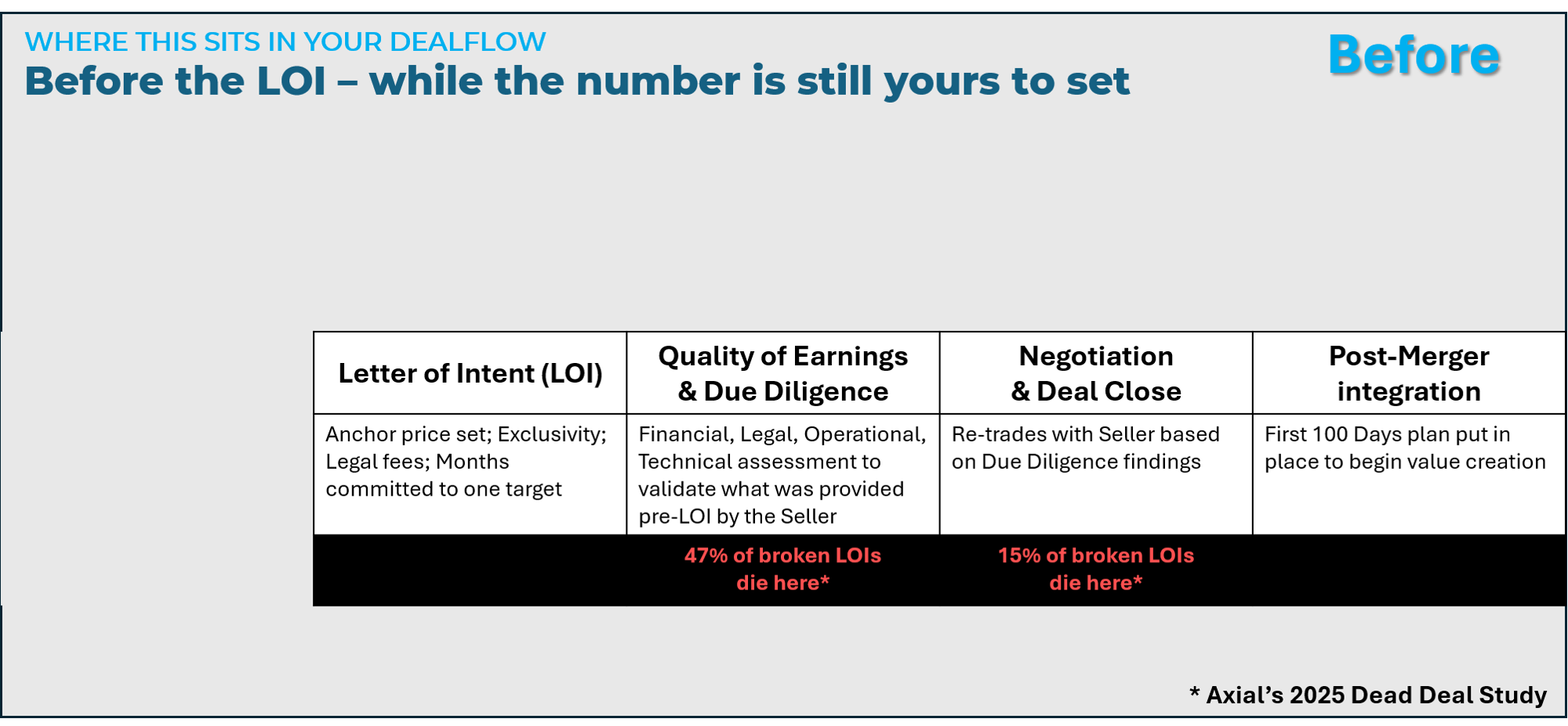
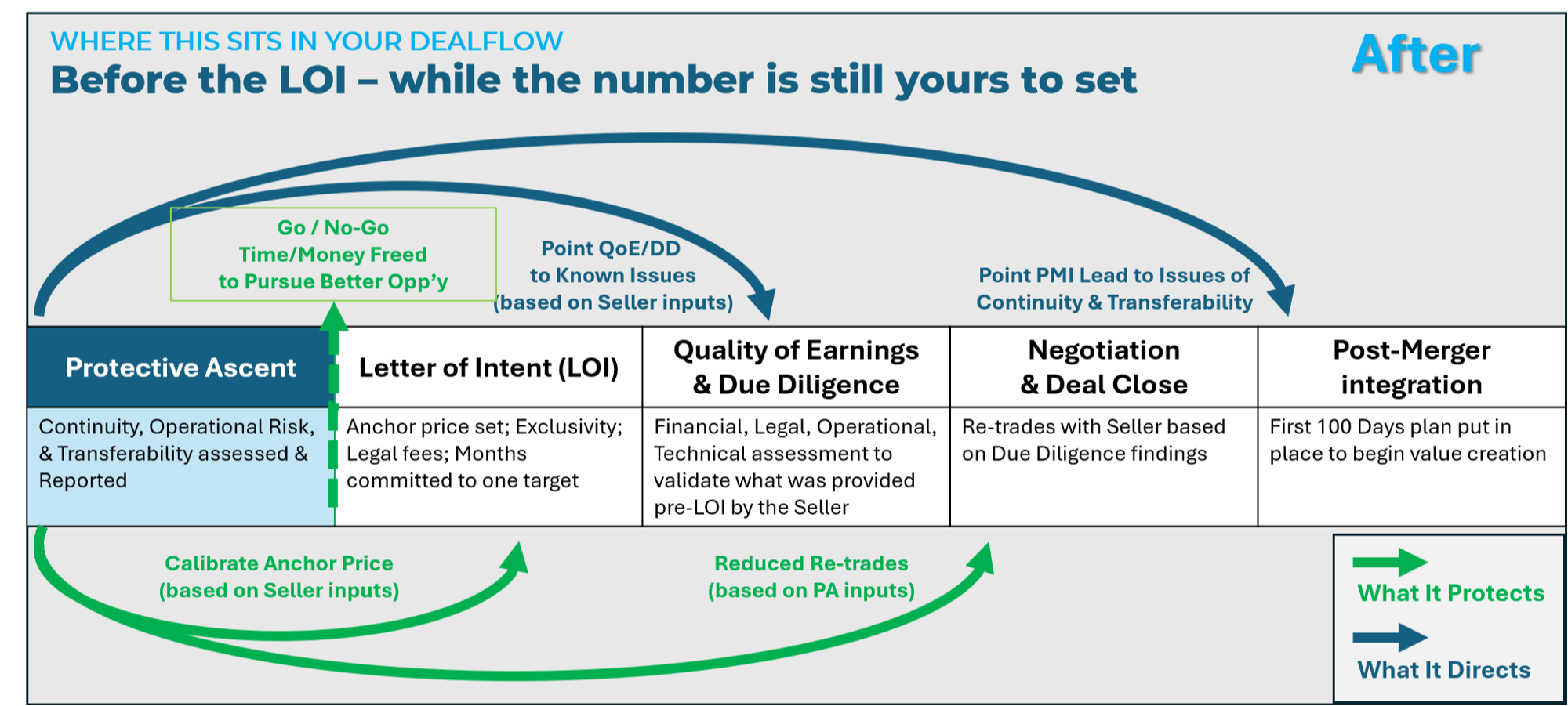
If you're viewing on mobile, turn your device for a better view of the image.
The operant transaction isn't the close — it's the price you start negotiating from, today. Post-LOI diligence can surface transferability issues, but usually as a byproduct of financial or legal review rather than the focus. This asks the question directly, on purpose — and puts the answer in your hands before you've named a price.
The Question your Diligence isn't Built to Ask
You've been through the CIM. Maybe you've already got a QoE provider lined up, or legal counsel reviewing contracts. That's the diligence everyone tells you to do — and you should still do it. But none of that is built to make this the primary question:
What's driving you to want to understand what actually continues to function once the seller is out of the picture?
Whether the pricing decisions run through one person's head. Whether the biggest customer trusts the company, or trusts the owner personally. Whether the team can actually run the place on day 31 without a phone call to someone who no longer works there. Standard diligence might stumble onto pieces of this. It isn't built to go looking.
This isn't a sign the business is poorly run — plenty of great businesses operate this way. It's a sign you need to know whether it's a factor before you decide what this is worth to you.
WHAT THAT COSTS WHEN YOU FIND IT LATE
Discovery findings, not line items
Customer relationships belong to the seller, not the business
The CIM said: "strong customer relationships." It didn't say with whom. Lost revenue, delayed value creation, and cascading retention effects as departing accounts talk to deciding ones.
$100K+
SIX FIGURESKey people were loyal to the seller, not the business
Direct spend on consultants, outsourcing, hiring, and training — plus every month spent backfilling instead of building. One departure can be absorbed. Multiples get dangerous. Across a portfolio, multiples become a pattern.
$100K–$1M+
SIX-TO-SEVEN FIGURESThe business is at capacity, with no systems to ramp
Uncommon, but it happens — and it can break the value thesis outright. When findings point here, the honest recommendation may be to walk away before the LOI, and we consult with you directly on that decision.
$1M+
SEVEN FIGURESWhat It Is — And Isn't
A Supplement to your Diligence, not a Substitute for it
This Is Not
- Quality of Earnings
- Financial due diligence
- Legal or tax diligence
- Cybersecurity or technical diligence
- Commercial diligence
- EBITDA recalculation or add-back validation
- A valuation
This Is
- Leadership Dependency — what stops when the seller leaves
- Knowledge Concentration — what lives only in someone's head
- Relationship Concentration — whose relationships these really are
- Decision Rights Mapping — distributed & documented or centralized & informal
- Management Depth — who leads when the seller isn't in the room
- Process Transferability — whether workflows survive the ownership change
The Experience Behind the Read
20years leading integration & transformation | 14industries |
$140Mnet-new value created for clients |
50+initiatives led, discovery through execution |
I developed the S.C.O.R.E. framework as the backbone of how that value gets identified, qualified, and translated to my clients.
Across resistant acquisitions, departments, and institutions, I learned to draw the truth out of the hiding, the hedging, the protective, the confident-but-mistaken, and the genuinely unaware. The point is to get to the core issues that can make or break an effort. Having come up through analysis before leading stakeholders and executives, I know how to speak to an audience in a way that invites them to reveal the truth rather than putting them on the defensive.
From there, I translate those findings — combined with deep knowledge of business systems and capabilities — into two distinct reads.
First, what will transfer cleanly through the transition and what won't — surfacing where Enterprise Value deserves a second look. Not a number, but a clear-eyed sense of what the business is actually worth once you separate what's transferable from what was riding on the seller.
Second, what's a foundation the business can be built on as currently configured, and what will need to be rebuilt first — the core of what drives Time-to-Playbook.
Together, those two reads answer the question that matters most before you name a number: whether you're standing in front of a Lexus, or a Toyota wearing a Lexus price tag.
Deliverables
What You Get
- Operational Continuity Report— a narrative read on continuity risk: what's strong, what's concerning, what's genuinely fragile
- Pre & Post Seller Self-Assessment - this is a Seller Self-Assessment and description of their business in their own words (very useful for coming to an understanding of where the business is, what is needed for transfer, and where due diligence should focus
- Counterparty (Seller) Profile - based on the interaction, will they be receptive and cooperative or defensive, evasive, and confrontational
- Continuity Risk Register — a prioritized list of the specific vulnerabilities found (knowledge concentration, relationship concentration, authority bottlenecks, and so on)
- Knowledge Transfer Priorities — what's currently living in one person's head instead of the business
Picture the Other Side
Picture walking into the first real conversation about price already knowing which lot you're standing in — Toyota money or Lexus money — instead of hoping the CIM's number holds up once someone starts asking harder questions. You've already seen where the shine is real and where it's lipstick, before spending the time, cost, and energy of QoE and due diligence to hopefully find out for yourself.
That's the immediate value: a baseline you can stand behind before you've named a number. What happens after that — if the deal moves forward — is real too, but it's downstream.
Whatever diligence still needs to happen is aimed at the specific areas that need a harder look, not a blanket search for problems you don't have a name for yet. The 100-day plan runs the way it's written because it was built on what the business actually is, not what the CIM or financial due diligence said it was. Value creation starts on day one instead of still rediscovering the business you bought months later.
And if you're running more than one deal a year, this compounds. A pricing baseline you can set the same way every time isn't just protection on this deal — it's discipline you carry into the next one, and the one after that. Surprises stop being a cost of doing deals and start being more time. energy, and money you can put toward money-making deals.
What's actually different for you and your team walking into an offer with that baseline already set? What is different heading into negotiations with the issues in hand, from the Seller's own perspective?
That's not an abstract efficiency gain. It's a confident read on the value the business really offers, before the negotiation starts.
If you have a LMM deal that you're actively working on, what is that worth to you?