
Why This Work Exists
I grew up as the child of a small business owner. When my mother’s business failed, there was no advisory layer, no outside perspective, and no one helping translate hard work into decisions that could actually hold. The impact wasn’t theoretical—it landed at home.
That experience didn’t send me straight into working with small businesses.
For the next twenty years, I worked inside large organizations across technology, healthcare, pharmaceuticals, utilities, banking, transportation, retail, manufacturing, nonprofits, and government—doing process improvement and performance work.
In those environments:
-
Risk is examined before action
-
Decisions are tested
-
Exposure is limited early
That work produced more than $140 million in measurable benefits, including cost reductions, recovered revenue, productivity gains, stronger retention, and time returned to leadership teams.
What stood out wasn’t that large organizations were smarter.
It was that they weren’t expected to guess.
Small business owners face many of the same pressures—but are rarely given the same kind of decision support, even though the consequences hit harder and faster.
Scaling Business Architects exists to bring that discipline back where it’s usually missing.
Not to turn small businesses into big ones.
Not to layer on complexity.
But to help owners see clearly, choose carefully, and avoid damage that doesn’t need to happen.
That’s why this work starts with stability.
And why failure is never treated as a personal flaw.
Built for Owners Who Don’t Have Room for Guessing
Scaling Business Architects (SBA) exists because many small businesses are being advised as if the environment is still forgiving.
It isn’t.
Costs rise before prices can.
Cash tightens unevenly.
One bad decision can take options off the table permanently.
Yet much of the advice aimed at small business owners still assumes time, margin, and recovery that may no longer exist.
SBA was created to work inside that reality—not to talk around it.
That’s why this work starts with stability.
And why failure is never treated as a personal flaw.
The Gap We’re Addressing
Most business advice quietly assumes a few things:
-
Problems are temporary
-
Mistakes can be corrected later
-
Growth will relieve pressure
-
More effort leads to better outcomes
Sometimes that’s true. Often it isn’t.
In tighter conditions, those assumptions push owners toward decisions that make things worse—expanding too early, committing cash too far out, or locking themselves into moves they can’t unwind.
SBA starts from a simpler premise:
If a business can’t absorb pressure, growth just magnifies the damage.
What SBA Actually Helps With
Scaling Business Architects helps owners make fewer bad decisions when the margin for error is shrinking.
We focus on:
-
Seeing where the business is vulnerable before it breaks
-
Reducing risk that doesn’t earn its keep
-
Sequencing decisions so early moves don’t box you in
-
Restoring options that have quietly disappeared
This isn’t about best practices or what worked for someone else.
It’s about understanding your business under current conditions—and choosing moves that still make sense if things tighten further.
Two businesses with the same revenue can be in completely different positions. SBA exists to surface that difference early, while it still matters.
Why We Don’t Start with
Growth, Tools, or Systems
We’re often grouped with scaling or systems firms. We understand why—and we intentionally work differently. We don’t begin with:
-
Automation
-
Tool stacks
-
Expansion plans
-
Efficiency programs
-
Motivation or pressure
Those approaches assume the business can absorb mistakes. When that assumption is wrong, the problem isn’t slow progress—it’s accelerated loss.
Our work is sequenced to avoid that.
Why This Work Exists
I grew up as the child of a small business owner. When my mother’s business failed, there was no advisory layer, no outside perspective, and no one helping translate hard work into decisions that could actually hold. The impact wasn’t theoretical—it landed at home.
That experience didn’t send me straight into working with small businesses.
For the next twenty years, I worked inside large organizations across technology, healthcare, pharmaceuticals, utilities, banking, transportation, retail, manufacturing, nonprofits, and government—doing process improvement and performance work.
In those environments:
-
Risk is examined before action
-
Decisions are tested
-
Exposure is limited early
That work produced more than $140 million in measurable benefits, including cost reductions, recovered revenue, productivity gains, stronger retention, and time returned to leadership teams.
What stood out wasn’t that large organizations were smarter.
It was that they weren’t expected to guess.
Small business owners face many of the same pressures—but are rarely given the same kind of decision support, even though the consequences hit harder and faster. For the historically-underserved business owners, many of those pressures are worse with fewer clear options.
Scaling Business Architects exists to bring discipline back where it’s usually missing and a clear path to better options to those who've historically been denied.
Not to turn small businesses into big ones.
Not to layer on complexity.
But to help owners see clearly, choose carefully, and avoid damage that doesn’t need to happen.
That’s why this work starts with stability. The tools and techniques that large corporations use to manage risk were never shared downstream. SBA exists to change that.
How This Shows Up Right Now
The current expression of this approach is Defensive Ascent. This is where we meet you—wherever your business is right now, without judgment about how it got there.
Defensive Ascent is for businesses that:
-
Are still operating, but feel pressure building
-
Are seeing margins, cash, or capacity tighten
-
Know some decisions can’t be undone
-
Want clarity before committing further
It’s a structured, time-bound engagement focused on understanding the health of the business, identifying real points of risk, and restoring decision leverage.
Defensive Ascent doesn’t assume growth. It assumes uncertainty—and plans for it.
Defensive Ascent is for owners who've been building without a safety net--and need one befoee they make their next move.
What Stability Actually Changes
Below are real-world scenarios drawn from small business profiles before and after working through Defensive Ascent.
Each comparison reflects changes in decision clarity, financial posture, operational strain, and owner capacity—not overnight growth or dramatic turnarounds. The goal isn’t transformation for its own sake. It’s regaining enough stability to make better decisions without compounding risk.
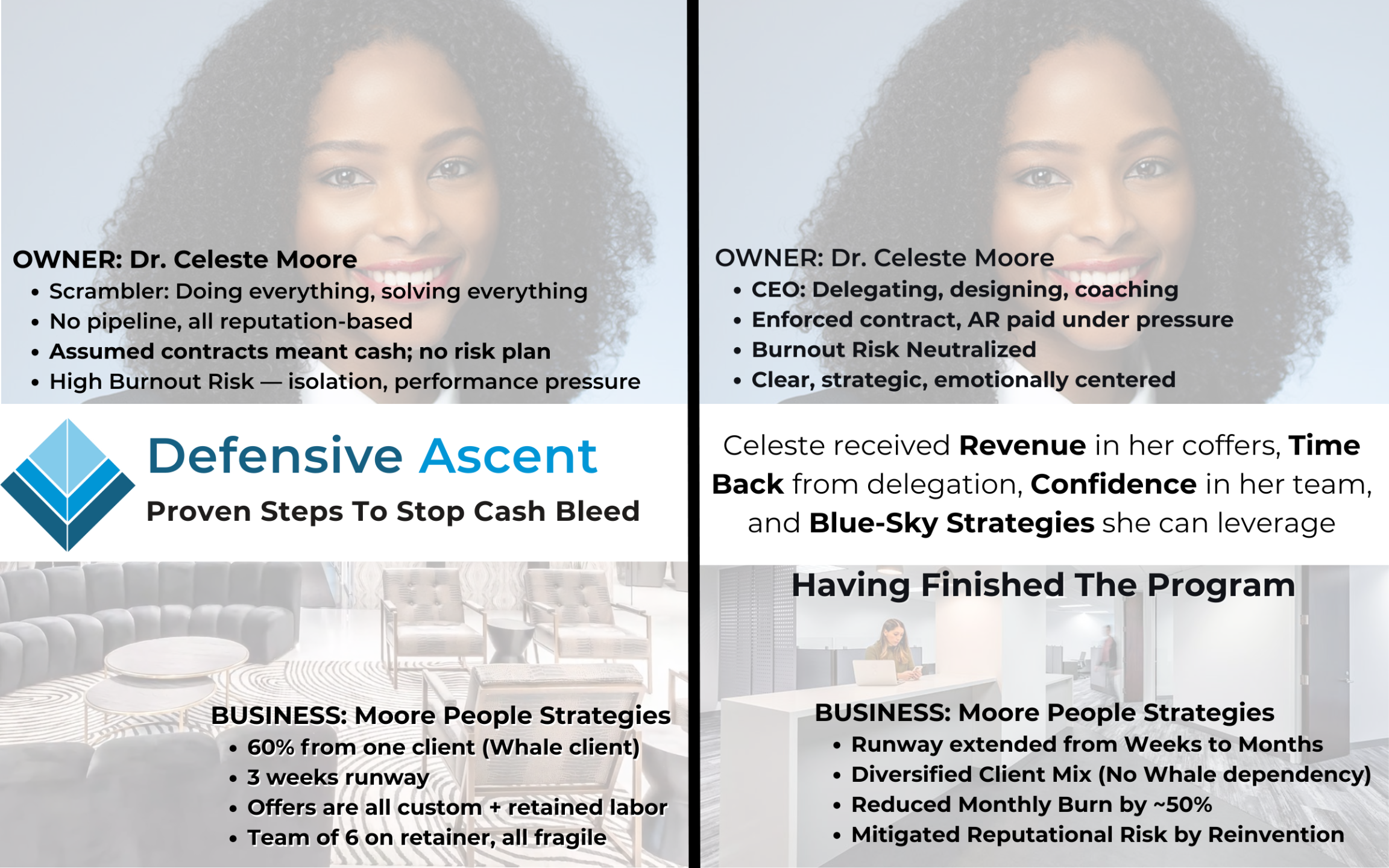
Dr. Celeste Moore
"Nearly sunk by losing a Whale client, SBA helped my business go from 3 weeks to more than 4 months of runway and gave me time to lead again."
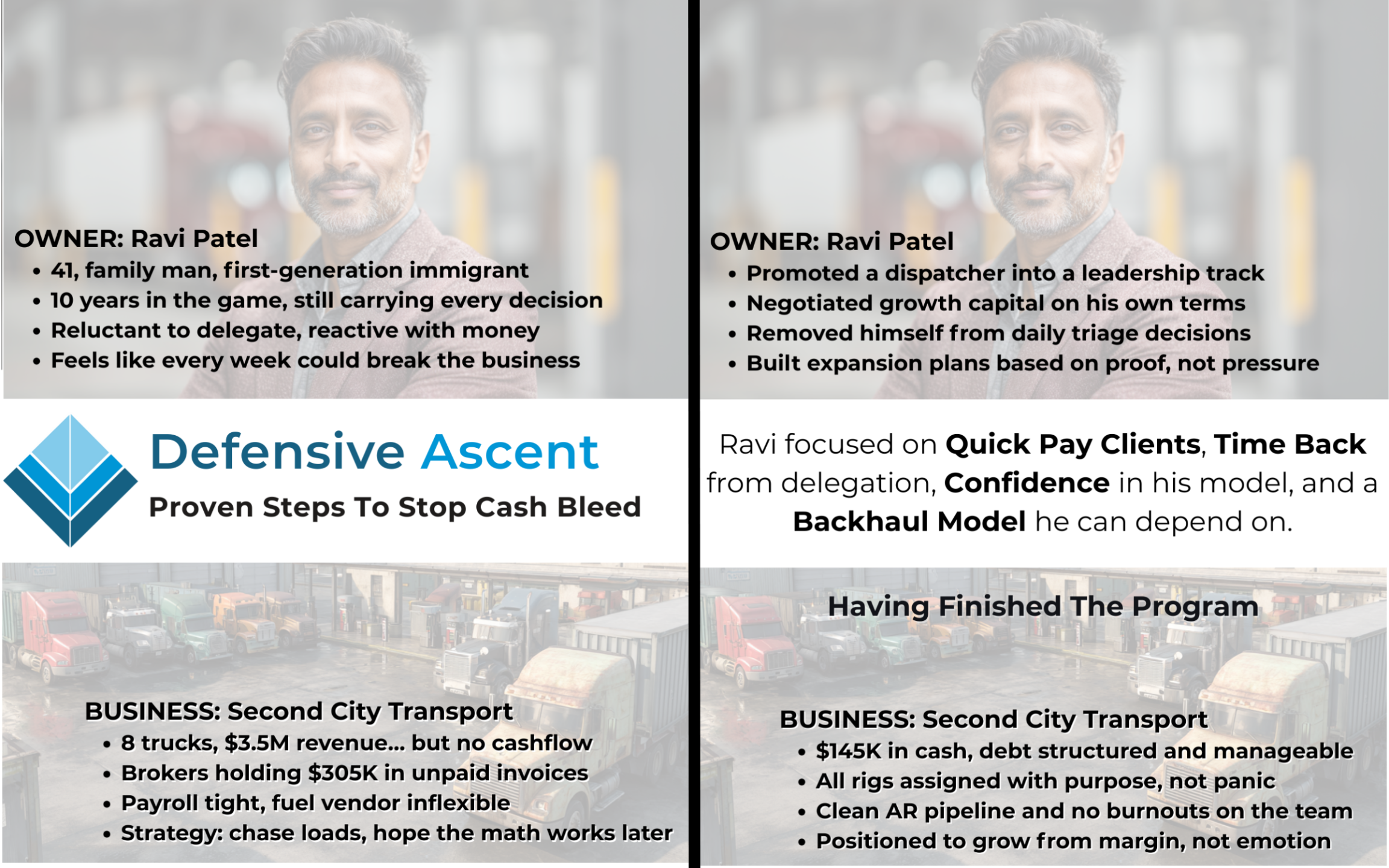
Ravi Patel
"My business was bleeding out but once I stopped chasing revenue and started protecting cash, my business turned around."
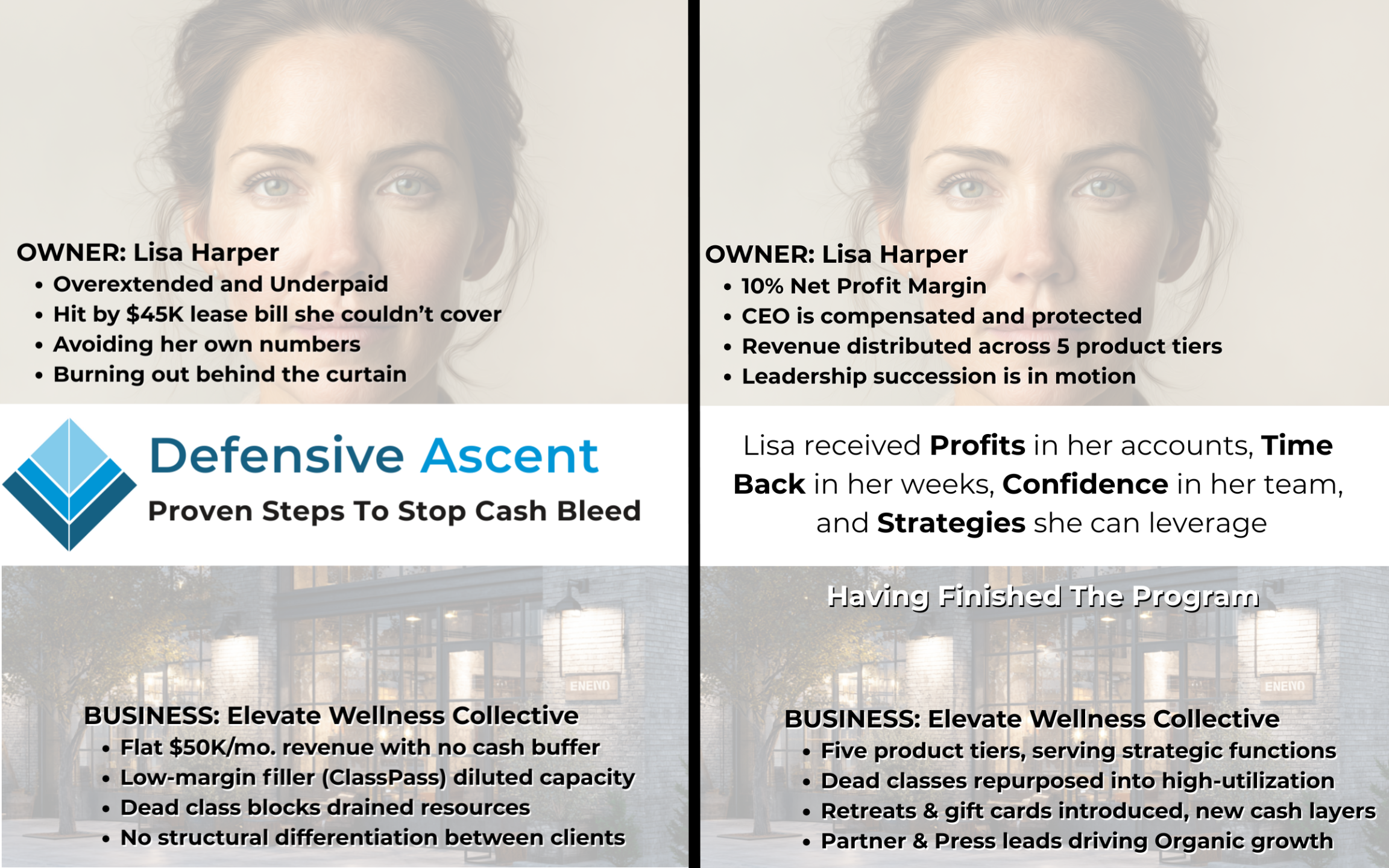
Lisa Harper
"Defensive Ascent didn’t just save my studio—it forced me to build a business strong enough to pay me, protect my team, and grow without breaking."
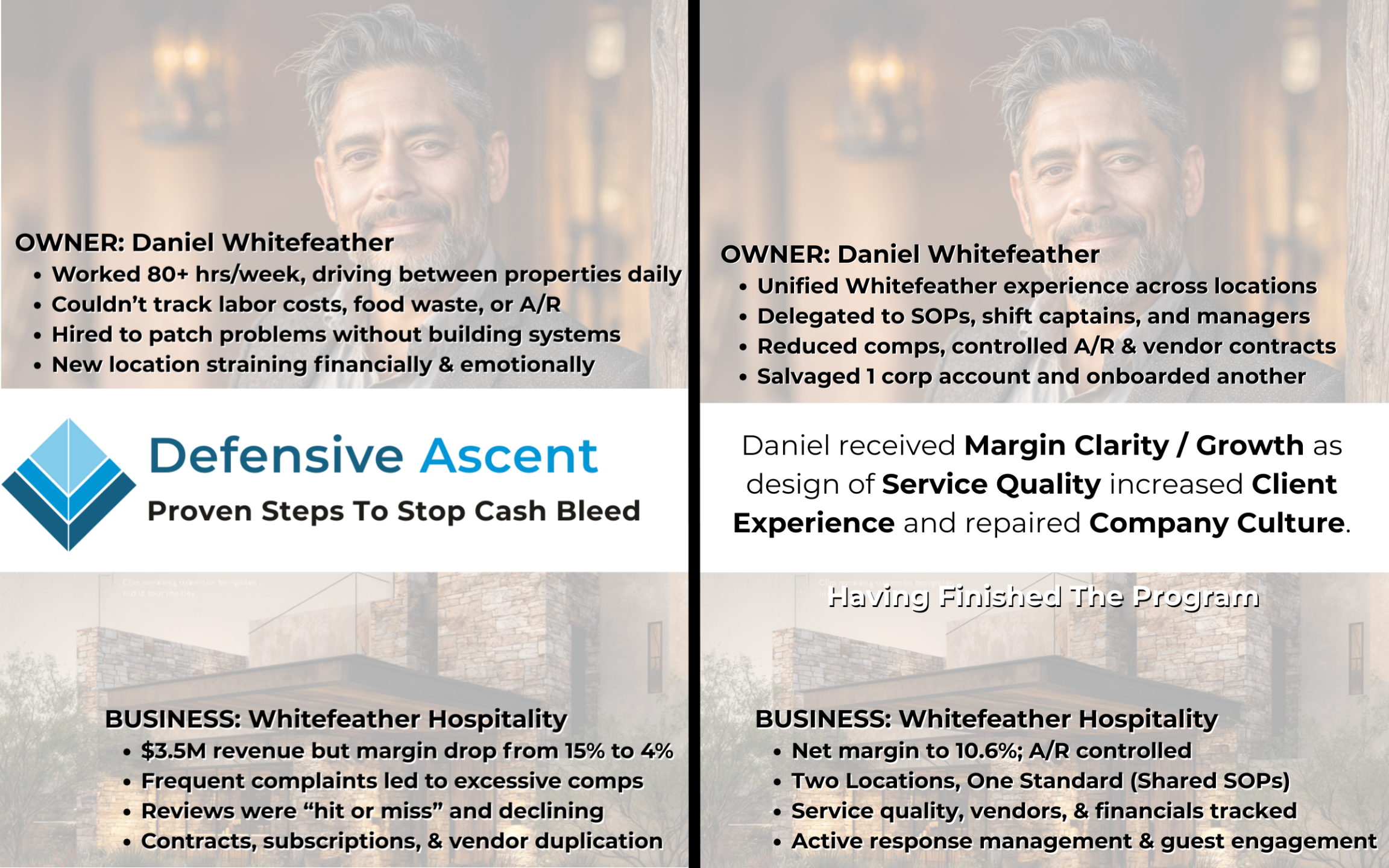
Daniel Whitefeather
"Kevin showed me how to stop being the hero of my business and start building a company that can win — and breathe — without me at the center of every decision."
A Straightforward Close
Scaling Business Architects isn’t for everyone.
It’s for owners who want fewer assumptions, clearer tradeoffs, and decisions that still make sense under pressure.
If that’s what you’re looking for, you’ll find alignment here.
If it isn’t, this won’t resonate—and that’s intentional.
Stability isn’t generic. It’s specific.
Ready to see where your business actually stands?
Assess Your Business Now!