

The Disclosure You Don't Get
Aug 03, 2026The Disclosure You Don't Get
By Kevin Goodwin | Built on Sand, Article 4 | Scaling Business Architects
TL;DR
Buyers often price lower-middle-market deals before seeing enough operational reality to know what will transfer. Limited, seller-only pre-LOI validation can surface risks before exclusivity, sunk costs, and negotiation anchors make them far more expensive.
Before You're Bound
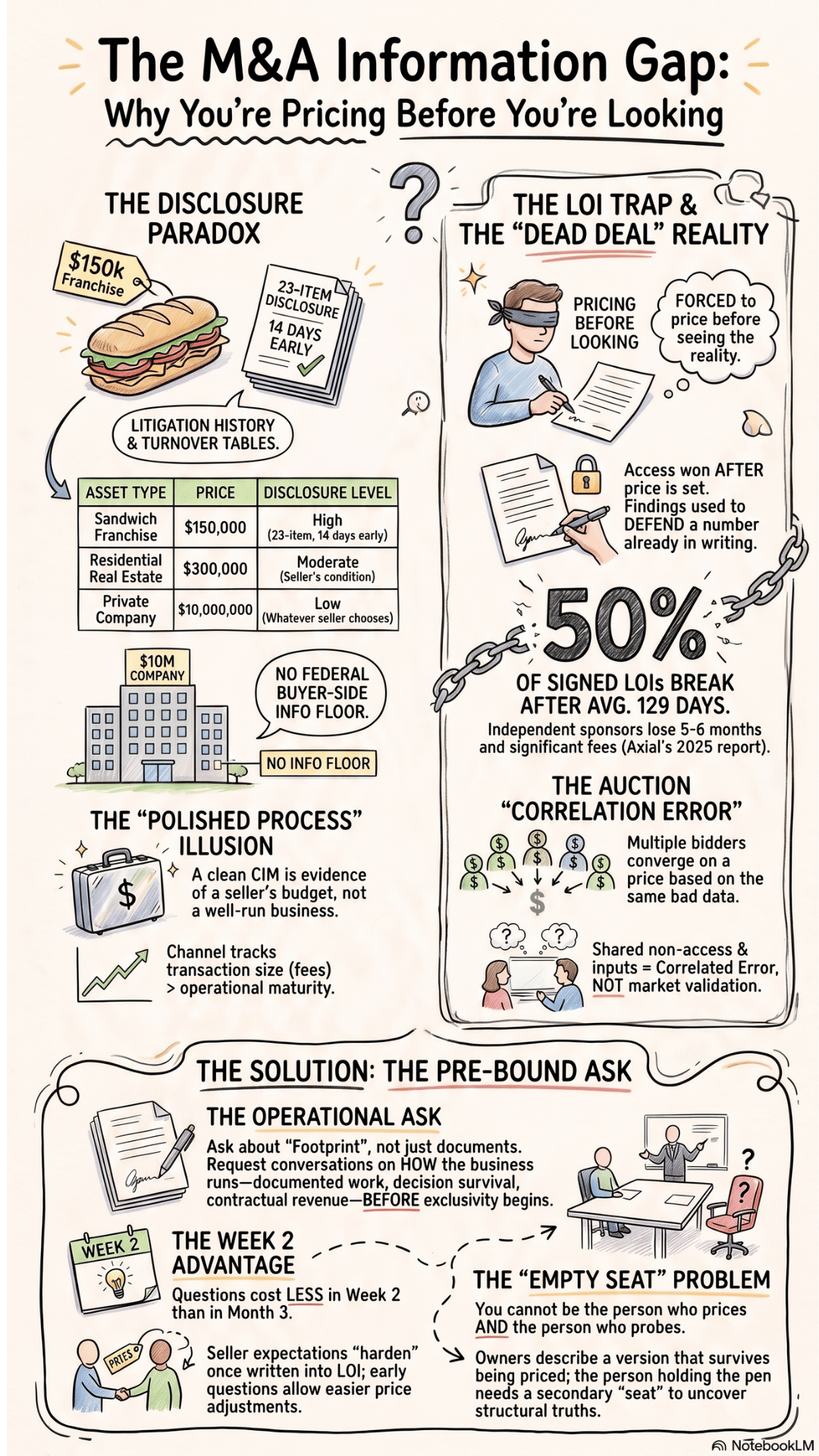
A $150,000 sandwich franchise comes with a twenty-three item disclosure document, delivered fourteen days before anyone signs anything. Litigation history, outlet turnover tables, and the phone numbers of former franchisees so you can call them yourself and ask how it went.
A $300,000 house, in most states, comes with a seller's condition disclosure.
A $10 million company comes with whatever the seller's side chose to assemble.
The one federal provision that reaches private-company M&A is the broker registration exemption, and its disclosure condition runs the wrong direction for us. In practice that is the seller taking rollover equity, getting a look at the buyer's HoldCo. The deadline is the purchase agreement, not the LOI. Federally, there is no buyer-side information floor anywhere in the sequence. Not financial, not operational, not at any point.
The stated rationale for the franchise rule is that a franchisee needs protecting. Nobody has ever written down the corresponding assumption about us, but it isn't hard to infer.
The Seat Nobody Occupies
Pre-LOI, the room is usually the seller, his advisor, and you.
Almost everything you would retain to examine a business is engaged on the far side of the signature. That is what those engagements are for, and nobody involved is doing anything other than their job. It just leaves your apparatus fully staffed for the period after the decision and thin for the period when the decision gets made.
So we read the process instead. Clean CIM, responsive advisor, organized data room — it feels like evidence the business behind it is well run.
It is evidence the seller could afford a process.
Which channel a business sells through tracks transaction size more than anything else, because fee size determines what infrastructure the sale supports. A $40 million business supports an auction. A $2 million business supports a listing. Neither tells you whether the work is documented, whether decisions survive the owner's absence, or whether the revenue is contractual. I have seen $40 million companies running out of one person's head. They just sell with better paper.
And from the outside, a business whose operational reality has been documented and held back is hard to distinguish from one where it was never articulated at all. Same silence, different cause, and opposite implications for what actually transfers at close. "What You Bought vs. What You Acquired"
Telling them apart takes access, which is the thing you don't have yet.
The Auction Can't Solve This
Four bidders converging on a price looks like validation. Mostly they read the same CIM, had the same non-access, and carried the same assumptions in. Some will have real edge — an adjacent portfolio company, industry history — but the shared inputs dominate. Closer to correlated error than corroboration.
I'd expect a seller to experience it as proof either way.
And the credential that earns you standing to ask for anything is an IOI, which is a number. You price before you're permitted to look. Whatever access you win afterward gets spent defending a figure already in writing.
Then the underbidders redeploy and the anchor doesn't. Sixty days into exclusivity the seller has fewer alternatives and more conviction than when he started, which is some part of why month-three retrades go badly.
It's also why pre-LOI operational work looks like it doesn't exist. In the most visible channel, it can't.
The Ask
Smaller than it sounds, which may be most of the reason it doesn't get made.
Nothing in it requires the data room. No customer list, no pricing detail, nothing an advisor needs to clear before release, and nothing the owner has to prepare. It's a conversation about how the business runs, answered from what he already knows.
I think the request lands harder than it should because of what the NDA is assumed to cover. It restricts disclosure to third parties and use outside the transaction. It was never built to stop a counterparty from repricing on what it learns inside one.
So the seller's exposure isn't leakage. It's that operational weakness surfaced before a number is set produces a lower number.
That's real, and it's mostly a question of timing, because these findings tend not to stay buried. They surface in diligence, or in your first year of ownership, or in the second time a key person leaves. The variable you control is whether they surface while both parties still have somewhere else to go.
None of which is an argument for everything before exclusivity. It's an argument for enough to know whether exclusivity is worth spending — and the scope discipline is practical, not just rhetorical. Confidentiality covers documents. It doesn't cover footprint. Customer calls and site visits are visible to people who never signed anything.
Nobody is granting that to a tire-kicker. Demonstrated capacity is the entry condition and it works the same in every channel. How much it buys you depends on how thin the field is — six approached and two real is a different seat than four verified bidders in a competitive process.
It's cheaper early, too, and I don't think that's about leverage. A first-time seller usually starts with something soft — retirement math, a peer's exit, a multiple heard at a conference. It hardens once it's written into a CIM, endorsed by an advisor, and repeated in front of interested parties. The same question costs less in week two than it does in month three.
Which is why how the ask is received is worth as much as the answers. An owner who engages and answers specifically has a business he can describe. One who engages and can't is running on undocumented knowledge, which is workable and priceable and where the work is worth the most. One who won't engage at all, having listed the business and retained someone to sell it, has given you a preview of the next four months.
Not the Person Writing the Check
One complication, and it's the reason this doesn't reduce to asking better questions.
An owner sitting across from the party who will price his business doesn't describe his operation. He describes a version of it that survives being priced. I've had answers come back technically true and structurally useless more times than I can count, and I don't read it as dishonesty — it's what any of us does selling anything.
The guard is calibrated to whoever holds the pen. Sharper questions don't move it.
So the seat that sits empty before the LOI isn't only unoccupied. It's one you can't take yourself, however sophisticated you are.
What comes out of that conversation isn't verified fact — nothing is, this early. It's what the seller was willing to state, where the account thinned out, and what that leaves to be tested. All of it arriving while the number can still move.
The Presumption
The alternative is the base rate we already run.
Axial's 2025 dead deal report puts independent sponsors at 129 days under exclusivity on deals that break, and more than half of signed LOIs break. Add the four to six weeks of process before the LOI and you're near five or six months, gone.
Both sides spent it. You spent it on one deal instead of a pipeline. He spent it off the market, running a business through a diligence process while his staff drew their own conclusions about the traffic. Fees are the part with an invoice attached, and they're the smaller half.
I'd also assume the reputational cost runs both ways, though I have no way to measure it. Intermediaries notice which buyers die in exclusivity. Buyers notice which businesses went exclusive and came back. Neither shows up on a statement, and both of them price the next transaction.
None of that proves operational findings caused the failures. It says commitment made without them holds up at a rate we'd question in almost any other professional process.
We accept it on a presumption. The buyer of a $10 million company is sophisticated, and sophisticated parties can protect themselves.
They can — on inputs. Sophistication is a faculty, not a credential, and a faculty with nothing to work on is a posture.
The information exists. Most of it is a couple of hours of the owner's time.
We should be asking for it before we're bound.
Don't miss a beat!
New moves, motivation, and classes delivered to your inbox.
We hate SPAM. We will never sell your information, for any reason.