
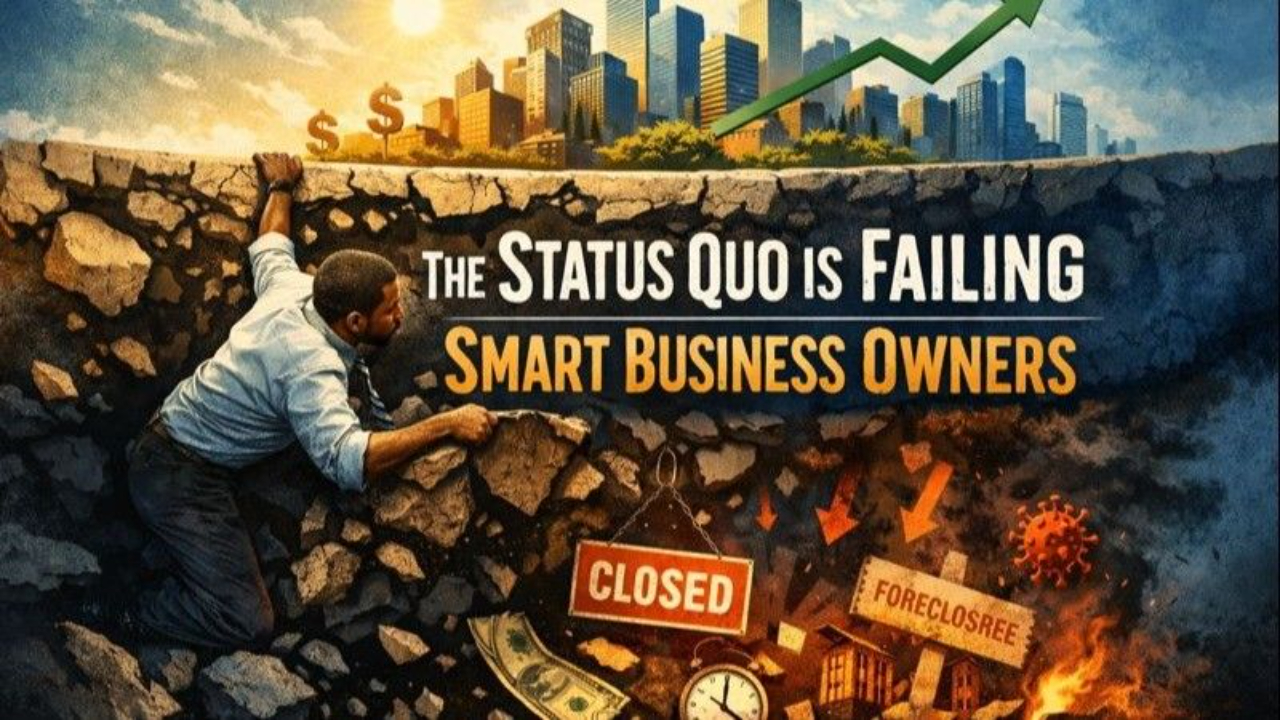
The Status Quo Is Failing Smart Business Owners
May 26, 2026There’s a quiet lie at the center of small business advice.
It says that if you’re smart enough, disciplined enough, educated enough, or hardworking enough, your business will survive.
For many business owners, that lie doesn’t just feel wrong anymore — it feels expensive.
Because over the last 25 years, owners have done everything they were told and still watched the ground shift under them.
Recessions. Credit freezes. Pandemics. Supply-chain collapses. Interest-rate shocks. Platform changes. Banking instability.
And through all of it, the advice barely changed.
Status Po: You followed the rules. You still paid the price.
The Status Quo Assumes Stability. Small Businesses Pay for That Assumption.
Most small business frameworks are built on an unspoken assumption: that the operating environment will be mostly stable.
Stable demand. Stable credit. Stable costs. Stable rules.
Federal survival data tells a different story. According to Small Business Administration analysis of Bureau of Labor Statistics establishment data, only about half of employer businesses survive to five years, and roughly one-third make it to ten — even before accounting for demographics or major economic shocks.
That’s not a stable system. That’s fragility being averaged away.
Status Po: Their assumptions get averaged. Your cash gets wiped.
Averages Hide Reality — and Shift Risk Downward
Aggregate survival statistics are often presented as reassurance:
“Half of businesses make it five years.” “Failure is just part of the journey.”
What those averages hide is how unevenly risk is distributed — and who absorbs the cost when the system breaks.
When outcomes are disaggregated, research from the Brookings Institution shows that certain groups of business owners experience dramatically worse survival outcomes than national averages suggest — particularly Black-owned and Black women–owned businesses.
This is not evidence of lower skill, weaker effort, or poorer decision-making.
Brookings and related research consistently point instead to structural differences in:
- Access to capital and credit terms
- Ability to absorb early losses
- Exposure to economic shocks
- Reliance on personal guarantees
- Margin for error during downturns
Disaggregated data doesn’t tell us who is failing. It tells us where the cost of instability is being concentrated.
Status Po: When the system breaks, the least insulated owners pay first — and pay more.
The Most Expensive Failures Happen After You’ve “Made It”
Most small business advice fixates on startups.
But establishment survival data shows that a significant share of failures happen after the first one to two years, not during formation. Years two through five are where businesses fail quietly — or survive while bleeding value.
This is when:
- Fixed costs lock in
- Debt becomes permanent
- Hiring outpaces margin
- Owner pay disappears
- Stress decisions replace strategic ones
The business may still be operating. The owner’s upside often isn’t.
Status Po: The business survives. Your wealth doesn’t.
Risk Isn’t the Problem. Uncontained Risk Is.
Here’s the part the status quo avoids:
No internal system can eliminate risk in a volatile economy.
Even well-run businesses are exposed to forces they can’t control — something the Federal Reserve has repeatedly acknowledged. Reporting on Federal Reserve Small Business Credit Survey findings, Barron’s highlights persistent stress from rising costs, tighter credit, and economic uncertainty across the small-business landscape.
Risk shows up whether you plan for it or not.
The difference is whether it’s recognized early and contained — or allowed to compound until there’s nothing left to protect.
Status Po: By the time it’s obvious, the money’s already gone.
Why the Status Quo Keeps Costing Owners Their Upside
The status quo rewards growth, scale, and optimization because those stories read well in calm conditions.
What it undertrains is:
- Cash discipline under stress
- Early containment over expansion
- Saying “no” before it’s urgent
- Protecting owner pay and optionality
So when shocks arrive — as they reliably have — owners absorb the losses personally.
Status Po: You took the risk. Someone else kept the upside.
What This Series Is About
This series isn’t anti-growth, anti-education, or anti-ambition.
It’s anti-denial.
It’s about why capable business owners keep losing profit, time, and wealth even when the business itself appears to survive.
Because in an economy defined by volatility, survival isn’t a baseline outcome.
It’s an achievement — and it deserves systems built for it.
Status Po: Staying alive isn’t the same as coming out ahead.
Want the rest of the series?
I’m publishing a limited series on why the small-business status quo quietly strips owners of profit and control — and what actually protects them.
Subscribe to the Combating Status Quo for SMBs newsletter to get the next article delivered directly.
Sources & Further Reading
SBA / BLS Establishment Survival Data Used to illustrate aggregate survivability and the limits of “average” outcomes. https://www.sba.gov/sites/default/files/2023-03/Frequently-Asked-Questions-Small-Business-2023.pdf
Brookings Institution — Disaggregated Outcome Evidence Used to demonstrate how aggregate averages mask unequal exposure to risk and unequal access to protective buffers — not differences in owner capability. https://www.brookings.edu/articles/reaping-the-unrealized-gains-of-black-businesses/
Federal Reserve Small Business Stress & Credit Conditions (via Barron’s) Used to substantiate ongoing macroeconomic pressure, credit tightening, and cost stress affecting small businesses broadly. https://www.barrons.com/articles/economy-small-businesses-warning-bdc6fadc
Don't miss a beat!
New moves, motivation, and classes delivered to your inbox.
We hate SPAM. We will never sell your information, for any reason.