
Your Revenue Is Real.
Your Cash Isn't Here Yet.

RECOGNITION
Eight trucks. Three and a half million dollars in annual revenue.
The kind of number that, when you say it out loud at a family dinner, makes people nod like they always knew you had it in you.
He built that. Loaded dock to loaded dock, years of saying yes to runs nobody else wanted, working relationships up and down the freight lanes until his name meant something. His father drove for someone else his whole life. Ravi owned the trucks.

From the outside, it looked exactly like the American dream. From the inside, he had three weeks of runway.
Not three months. Three weeks. Twenty-one days between the account balance he checked every morning from the cab and the version of the conversation he didn't want to have with anyone. His wife did the books — every night after the kids went down, kitchen table, laptop open next to whatever was left of dinner. She was good at it. She saw everything. The invoices that went out on time and came back sixty days late. The fuel bills that couldn't wait. The insurance that renewed whether the loads were there or not.
At some point he stopped mentioning when a payment was late. Not because he was hiding it. Because saying it out loud made it more real than he could afford for it to be.
He'd sit in the cab before his first load of the day and check the balance. Not to make a plan — there was no plan, just the number and what it meant about the next seventy-two hours. Good number, decent day. Bad number, figure out which call to make first. He got very good at reading the difference between a client who was going to pay and a client who was going to stall, and what he mostly felt was tired.
"My trucks were moving. The work was getting done. Revenue looked good on paper. But I was constantly worried about payroll, fuel, maintenance, and whether payments would arrive before I had to pay someone else. I was carrying the business on my shoulders and convincing myself that if I just kept everything moving, things would eventually work out."
- RAVI PATEL, SECOND CITY TRANSPORT*
THE PATTERN

Here is what nobody tells you about a cash conversion business:
The money goes out on a clock. Fuel, insurance, maintenance, payroll — all of it runs on a schedule that does not care about your receivables. The money comes in on someone else's mood. Whether the AP clerk at the distribution center got to your invoice today. Whether the account manager remembered to approve it. Whether the thirty-day terms you agreed to became sixty because that's just how they do it and you didn't push back because you needed the load.
That gap — between when the money leaves and when it arrives — is not a cash flow problem. It is a structural timing mismatch that compounds every single week you don't name it.
Ravi wasn't in trouble because his business was failing.
He was in trouble because his business was succeeding on terms that were slowly draining him.
More loads meant more fuel on the front end. More revenue meant more receivables on the back end. Every truck he added made the timing gap wider. He was building a bigger and bigger engine and running it on a tank that was always almost empty.
Instead of asking, "How much revenue did we do?"
I started asking, "How quickly does the cash come back?" and "What does this load actually do for the business?"
That changed almost every decision we made.
- RAVI PATEL, SECOND CITY TRANSPORT*
He didn't need another client. He didn't need better rates.
He needed someone to sit down with the actual numbers and show him where the structure was working against him — and what to fix first, in what order, before the tank hit zero.
That's what happened.
THE TURN

Twelve weeks.
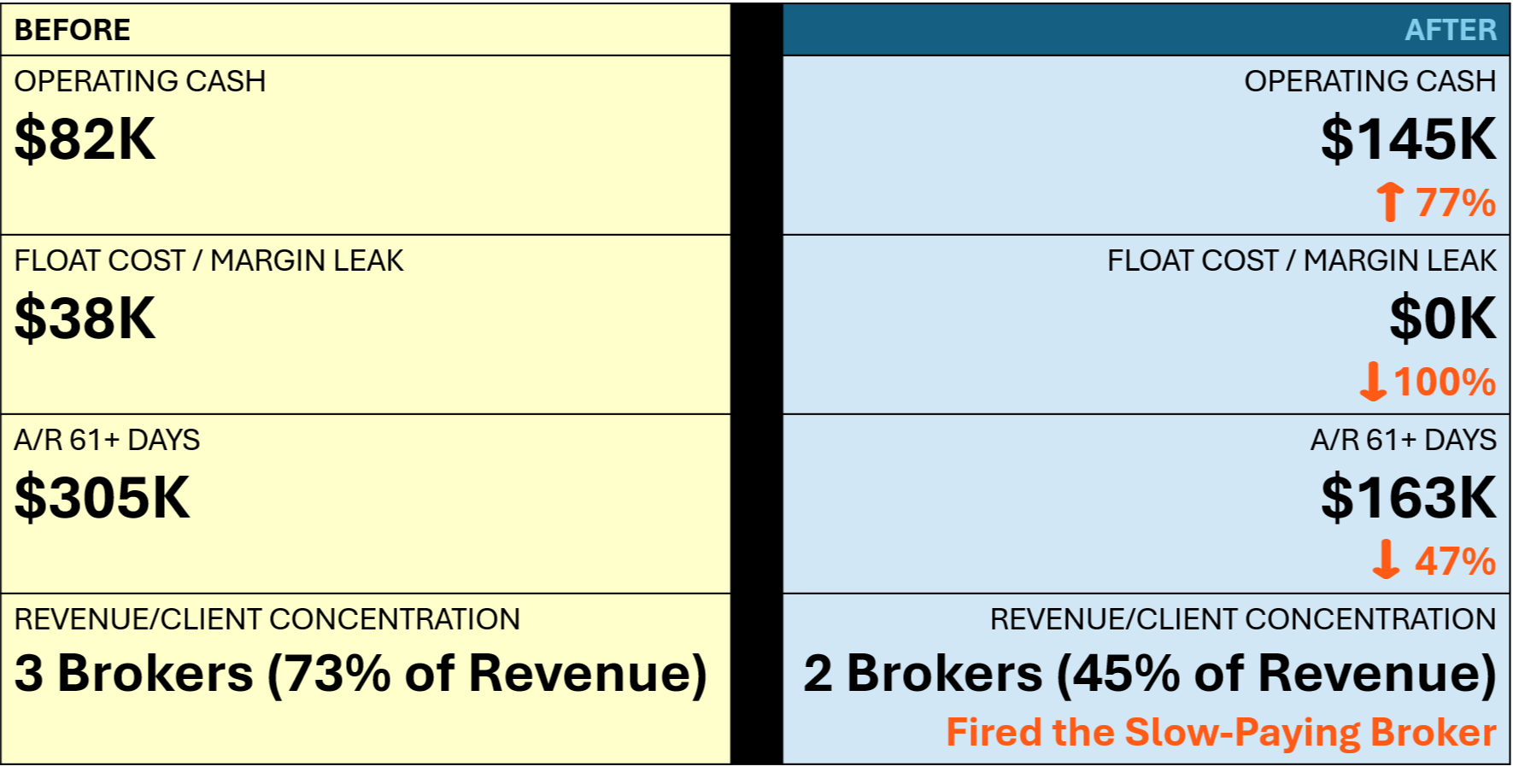
Seventy thousand dollars in outstanding AR — collected, with a system in place so it wouldn't pile up again. Gross profit up twenty-three thousand a month. Runway tripled — three weeks became nine. Broker dependency mapped and reduced. Cash position visible week by week instead of morning by morning from a cab.
He's planning for fifteen trucks now.
Not because someone handed him a growth strategy. Because the eight he already had finally have a floor under them. He knows what they cost, what they generate, and what the timing looks like between the two. He knows what a bad month looks like before it becomes a crisis.
He still checks the balance in the morning. But now it's to plan.

"By the end of the process, I started building systems and people that could carry some of that weight.
I learned that leadership isn't being the person who fixes everything. Leadership is creating a business that can withstand pressure without requiring constant rescue."
- RAVI PATEL, SECOND CITY TRANSPORT*
WHAT'S NEXT
Your Credit Line balance tells the story your Revenue number doesn't.
Your credit line balance is higher than it was six months ago and you can't point to a capital investment that explains it. You're covering operating expenses — payroll, supplies, recurring costs — with money you're borrowing against future revenue that's already been earned, already been invoiced, and just hasn't arrived yet.
That's not a discipline problem. That's a timing problem with a name and a fix.
The DA Business Assessment takes 20 minutes. It looks at your business across five structural dimensions and tells you exactly where the pressure is coming from — including the cashflow timing patterns most owners are trapped inside without being able to see their way free to the outside.
You don't need to have it figured out before you take it.
That's what it's for.
* This use case is based on our engagement with a real Scaling Business Architects' Defensive Ascent client. Out of respect for their wish to not have their past or their business partners/employees business out publicly, we've changed the names and location of the Owner and Business.
** The performance uplift as accurate to what they reported.