
You Haven't Paid Yourself
Since You Stopped Counting

RECOGNITION
Danielle runs a catering company that, from the outside, looked like it was doing fine.
Eight hundred thousand a year. Six full-time staff, more during event season. Weddings, corporate events, private parties. The food was good — really good. The clients were happy. The referrals kept coming. If you went to one of her events you'd have walked away thinking she had it figured out.
Here's what nobody at those events could see.

Her business partner had left. Her marriage had ended. She was making a buyout payment every single month for a share of the business she now ran alone. And somewhere in the middle of holding all of that together, she had become the answer to every question the business could ask.
A client had a request — she handled it. A vendor issue — she handled it. Staffing fell apart the morning of an event — she handled it. An invoice didn't get paid — she handled it. Food ordering, scheduling, the difficult phone call nobody else wanted to make — her, her, her.
The business wasn't running on systems. It was running on her.
Is This You? → Take The AssessmentTHE PATTERN
And the thing about a business that runs on one person is that the person is the cheapest resource to spend. So she spent herself. She'll tell you exactly when it started:
"I hadn't paid myself since October. I was living on savings, credit cards, and a HELOC."
Danielle Whitfield, Whitfield Catering & Events*

Read that again. A month. Three funding sources. That's not a vague impression of financial stress — that's a woman who knew the exact shape of what she was doing to herself and kept doing it because she'd convinced herself it was temporary.
Every month felt like a gamble. Every event felt like it had to work. Every lead felt like something she couldn't afford to turn away — even the bad ones, even the clients who chewed up her staff and paid late and demanded more than the contract said. Because turning work away felt like the one thing a struggling business can't do, even when the work was part of what was making it struggle.
She told herself she was doing whatever it took to save the business. What she was actually doing was disappearing into it.
And here is the part that matters most, the part she named herself when she finally said it out loud:
"The hardest part wasn't the money. The hardest part was feeling trapped. I couldn't take a day off. I couldn't stop paying attention. I couldn't step away because there wasn't anyone else to step in."
Danielle Whitfield, Whitfield Catering & Events*
That's the real cost of not paying yourself. It was never really about the draw. The unpaid draw was just the most visible symptom of a deeper arrangement — one where the owner has quietly agreed to be consumed by the business in exchange for keeping it alive. And the cruelest part is that it feels like virtue. It feels like dedication. It feels like exactly what a committed owner is supposed to do.
"For months I had convinced myself that the business could survive as long as I sacrificed enough."
That sentence is the whole trap in nineteen words.
Seeing The Signs? → Take The AssessmentTHE TURN
What changed wasn't that she found more revenue. It's that she stopped believing more revenue was the answer.
The money she needed wasn't in the next event. A lot of it was already sitting in accounts receivable — work she'd already done and simply hadn't built a system to collect. Twenty-eight thousand dollars of it was more than sixty days overdue. She brought that down to zero. Not by chasing harder. By building the collections process she'd never had time to build because she was too busy being the collections process.

Then she did the harder thing. She started looking at which events actually made money versus which ones just made her busy — and she stopped taking the ones that were costing her. She gave the front of house to her event manager. She gave the kitchen to a sous chef. She gave collections to someone whose whole job was collections. Every time she handed something off, the thing she feared — that it would fall apart without her — didn't happen. Most of the time it got better.
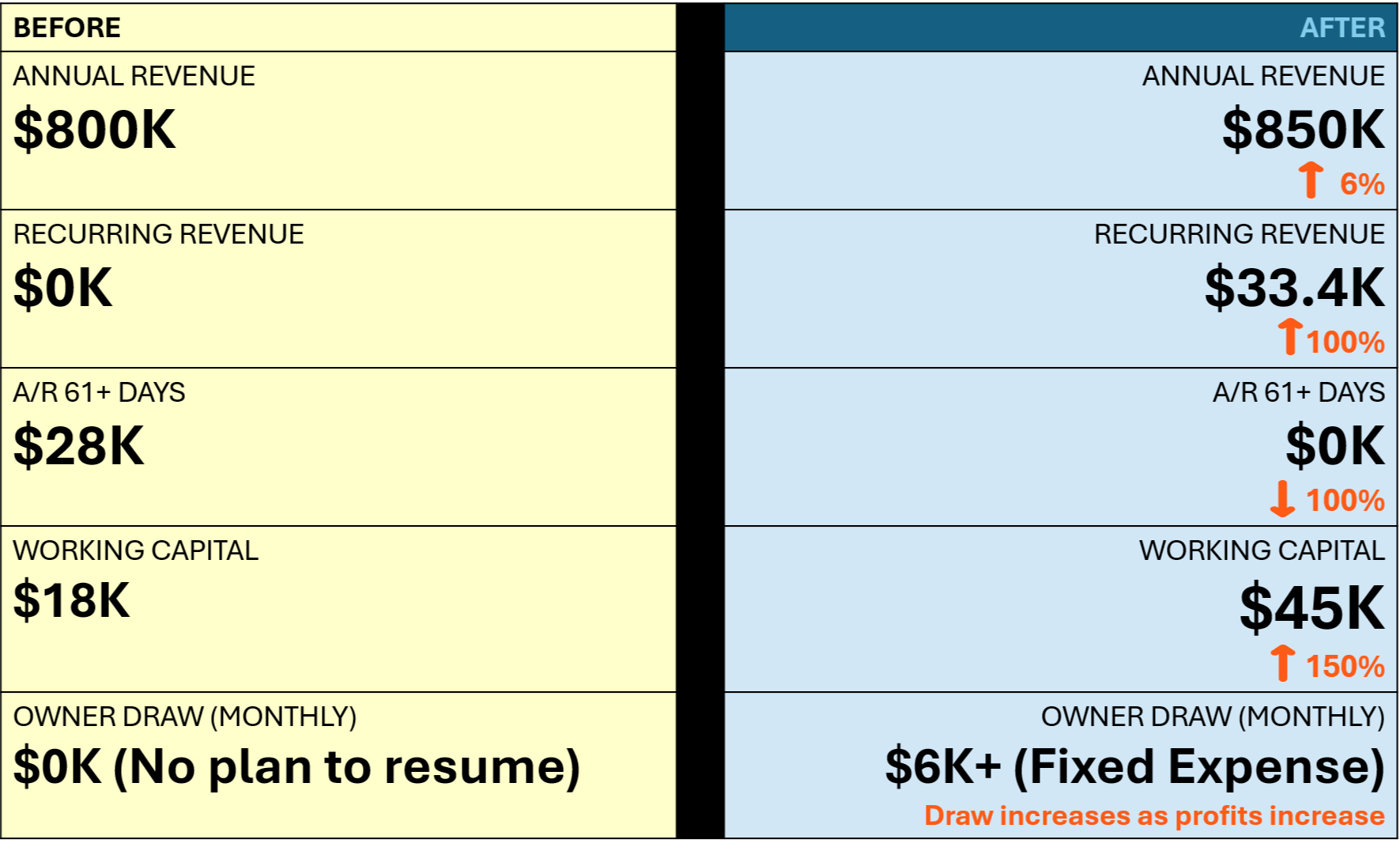

Owner draw went from zero, to resumed, to a fixed policy she now holds the business to. But the number on the check was never the point. The point was what the check meant: that she was no longer the line item the business spent first.
She'll tell you the business still isn't perfect. It has risks. It has goals. But the risks are different now:
"They're growth questions now. They're governance questions. They're leadership questions. They're not survival questions."
Want Results Like That? → Take The Assessment"Personally, one of the biggest moments was paying myself again. Not because the amount of money was life-changing. Because it represented something deeper.
Receiving regular compensation again was proof that the business wasn't just consuming me anymore. It was beginning to support me again."
- DANIELLE WHITFIELD, WHITFIELD CATERING & EVENTS*

WHAT'S NEXT
If you've stopped paying yourself — or you're paying yourself last, and least, and only when there's something left over — the business is asking you to absorb a structural problem with your own life.
It isn't dedication. It isn't temporary. It's the most flexible line item in the budget getting cut over and over because it's the one that doesn't send an invoice or quit.
The Defensive Ascent Business Assessment takes twenty minutes. It maps where the business is consuming you instead of supporting you — owner dependency, cash conversion, the difference between revenue that's making you bigger and revenue that's just making you busier.
You don't have to have it figured out. You just have to be willing to look at how long it's been.
TAKE THE DA BUSINESS ASSESSMENT* This use case is based on our engagement with a real Scaling Business Architects' Defensive Ascent client. Out of respect for their wish to not have their past or their business partners/employees business out publicly, we've changed the names and location of the Owner and Business.
** The performance uplift is accurate to what they reported.