
You Know Which Client It Is.
You don't need to look it up, it's already in your head

RECOGNITION
Darnell built a staffing company the right way — one relationship at a time, one reliable placement at a time, a decade of showing up when other agencies didn't. By the
time he hit $1.2 million in revenue, he had a reputation.
Clients called him. That's not nothing. That takes years.
Then he landed the whale.

A regional distribution center. Hundreds of workers placed. Shifts filled around the clock. The kind of account that makes you feel like you've finally arrived — the account that, when you tell other business owners about it, makes them go quiet for a second because they wish they had it.
Six hundred thousand dollars a year. Thirty-five percent of everything he had.
He told himself it was growth.
"When I started, I thought I was eight weeks from missing payroll. What I discovered was that I was eight weeks from losing control of the business."
- DARNELL WASHINGTON*
THE PATTERN
The invoices went out on time, every time. The payments came back at ninety days. Sometimes longer. The account manager was friendly about it. Always had a reason. Processing backlog. New AP system. End of quarter freeze. Darnell kept staffing the site because he couldn't afford to lose the volume, and the account was too big to push hard without risking the relationship, so he waited, and the invoices stacked up, and the receivables balance grew, and the credit line he used to bridge payroll started climbing month by month — and he told himself he'd pay it down when the big check cleared.
The big check always cleared. Eventually.

But here's what was happening underneath that, in the parts of the business he didn't have time to look at: his two best recruiters burned out on the distribution center's chaos — the last-minute shift changes, the constant churn, the client contact who called at seven in the morning like it was normal. They started quietly reaching out to competitors. He didn't find out until one of them was already gone. The accounts that had always paid in thirty days, the clients he'd built his reputation with, started getting his B-team coverage because his A-team was underwater in the whale's orbit.
He was not growing. He was subsidizing the distribution center's staffing operation with his own cash, his own people, and his own future.
"I didn't grow to $1.8 million.
I grew to $1.2 million and added
$600,000 in damage."
- DARNELL WASHINGTON, WASHINGTON STAFFING SOLUTIONS*
The revenue was real. The invoices were real. The work had been done. But the business behind the number — the cash position, the team depth, the client relationships he'd spent a decade building — was quietly being consumed to service an account that was paying him on their schedule, not his.
He didn't have a sales problem. He didn't have a delivery problem. He had a concentration problem he'd mistaken for a success story.
What this pattern looks like
When a single client represents 30% or more of revenue and pays past terms, the business isn't carrying a collections problem. It's carrying a structural dependency that grows more expensive — in cash, in people, in opportunity cost — with every month it isn't named.
THE TURN

What changed: he stopped asking how to keep the whale happy and started asking what the whale was actually costing — in cash, in people, in the accounts that were being starved while all the attention pointed one direction. The answer was not comfortable. The decision that followed it was not easy.
But here is what was on the other side of it.
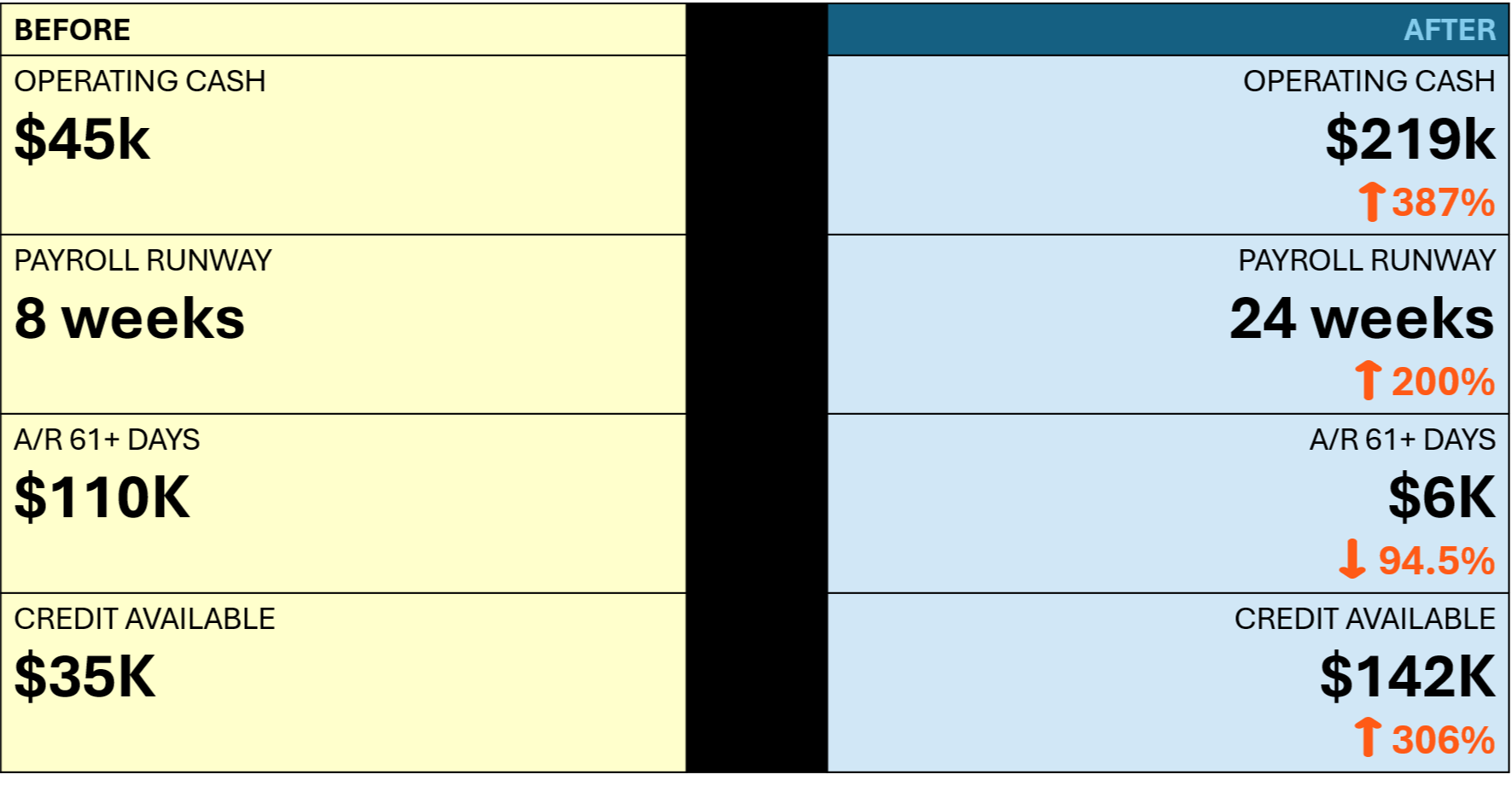
Washington Staffing Solutions - Greensboro, NC - 12 Weeks (Defensive Ascent)**
"The most important lesson I learned is that the business was not struggling because I didn't care enough. It wasn't struggling because I wasn't working hard enough. It was struggling because I didn't have the visibility and decision discipline needed to manage complexity...yet."
- DARNELL WASHINGTON, WASHINGTON STAFFING SOLUTIONS*
By the time he understood what his business was dealing with, they was in too deep. He'd already moved my best people over. He'd already committed recruiting resources. And the revenue... on paper it looked like the account that was going to take the business to the next level.
Thirty-plus temps at bill rates that looked good until you factored in the turnover cost, the constant re-recruiting, the workers' comp exposure on a high-injury site, and the fact that they don't pay on time."
"Their last staffing company walked away. I'm starting to understand why."

WHAT'S NEXT
YOU ALREADY KNOW WHICH CLIENT THIS IS
The question is what it's actually costing you.
In cash. In attention. In the parts of the business that aren't getting what they need because this one account is consuming everything. From the inside, it doesn't look like risk. It looks like revenue.
The DA Business Assessment takes twenty minutes. It surfaces concentration risk, receivables exposure, and the structural patterns that are easiest to miss when you're inside them.
TAKE THE DA BUSINESS ASSESSMENT →
* This use case is based on our engagement with a real Scaling Business Architects' Defensive Ascent client. Out of respect for their wish to not have their past or their business partners/employees business out publicly, we've changed the names and location of the Owner and Business.
** The performance uplift as accurate to what they reported.