
The Revenue Looks Fine
So Why Doesn't It Feel Fine?

RECOGNITION
Lisa built the kind of place you walk into and immediately understand that someone cared.
Not in a corporate, brand-standards way. In the way where the light is right and the music is right and the person at the front desk actually seems happy to see you. The kind of place that gets written up on local blogs and passed around between friends the way good restaurants get passed around — quietly, loyally, because people feel something there and want other people they care about to feel it too.

Six hundred thousand dollars a year. Full calendar. Waitlisted on weekends. Client retention that most businesses would not believe if you showed them the numbers.
She hadn't opened her own P&L in four months.
Not because she didn't have access to it. Because the last time she looked, it told her something she wasn't ready to deal with, and she had a full schedule the next morning and a staff meeting in the afternoon and there wasn't a good time to sit with what the numbers were saying, so she closed the laptop and moved the envelope with the lease renewal terms from her desk to a drawer where she wouldn't have to see it every time she sat down.
Is This You? → Take The AssessmentTHE PATTERN
This is not a story about a failing business.
This is a story about what margin erosion actually looks like from the inside — not a dramatic collapse, not a crisis moment, just a slow, quiet narrowing that happens in the spaces between the busy days, one decision at a time, each one reasonable on its own, none of them catastrophic, all of them adding up to a margin that had gone from workable to thin to something she was covering out of pocket without telling anyone.
"The truth was that we were operating with almost no margin, almost no cash reserves, and no room for error. I had built a luxury experience on a very fragile financial foundation. One unexpected expense was enough to put the entire business at risk."
Lisa Harper, Elevate Wellness Collective*

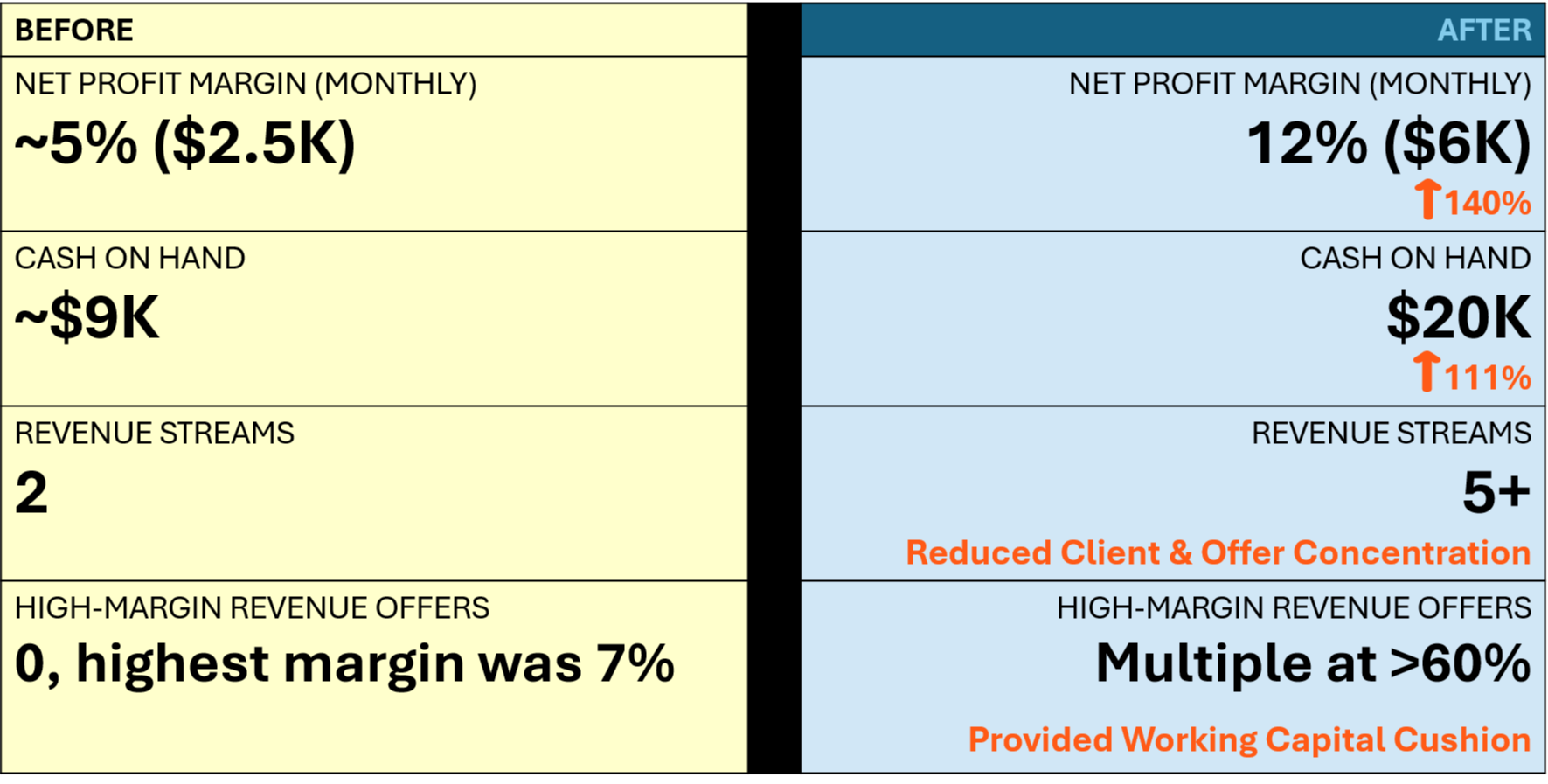
Five percent. That was what was left after the rent that had gone up at renewal, the instructors who needed consistent hours and benefits to stay, the software and insurance and supplies and all the other line items that were each a small number and none of them optional. She had raised prices once — reasonable increase, she'd been underpricing for years — and lost three clients she couldn't afford to lose, clients who anchored other clients, and the fear of that happening again was enough to keep prices where they were while everything around them kept going up.
So she did what business owners do when margin is thin and they don't know where else to look: she worked more. Added a class here. Extended hours there. Filled every gap in the schedule herself before adding staff cost. More revenue, more output, same structure underneath — which meant more revenue flowing through a system that was losing a little more on every dollar than it had the year before.
More work. More revenue. Less left.
There's a particular exhaustion that comes with this pattern. It's not the exhaustion of a bad business. It's the exhaustion of a good business that's working against you — where effort produces results and the results somehow don't produce what you need, and you can't quite figure out where it's going, and after a while you stop looking closely at the numbers because looking closely doesn't seem to change anything and you have enough to get through the month and you just need to get through the month.
Everybody around her thought she was thriving. The studio looked beautiful. The clients loved it. From every angle you could see from the outside, she had made it.
"That's the loneliest part of margin erosion. The room is full and you're drowning in it."
- Lisa Harper, Elevate Wellness Collective*
She didn't tell her team. She covered the shortfalls herself. She kept moving, kept filling the schedule, kept doing the thing that had always worked — more effort, more output — without being able to see that the problem was structural, not operational. She wasn't working in the wrong way. She was working inside the wrong structure. And no amount of effort was going to fix a pricing model, a cost architecture, and a service mix that were slowly consuming the margin the business needed to survive.
Seeing The Signs? → Take The AssessmentTHE TURN
What she needed wasn't a growth strategy. She needed someone to sit with her while she opened the drawer.
That's what happened.
Twelve weeks. Margin doubled. The lease situation was resolved. Ten hours a week came back to her — not from working less, but from eliminating the service lines that were consuming time without producing margin. She told her team the truth. She had been afraid of what that conversation would do to the room. What it actually did was make the room smaller and stronger. They didn't leave. They showed up differently — with more context, more ownership, more of the investment that comes from being trusted with the real situation.

She didn't fix it by wanting it more or pushing harder. She fixed it by finally opening the drawer with someone in the room.
Two service lines that were consuming time and producing almost nothing were eliminated — and the schedule got shorter without the revenue collapsing, which surprised her, because she had believed for years that the volume was load-bearing. Ten hours a week came back to her. Not from working less. From working inside a structure that was no longer working against her.

She told her team the truth. She had been dreading that conversation for months — the fear that saying it out loud would change how they saw her, or the business, or whether they wanted to stay. What it actually did was something she didn't expect: they showed up differently afterward. With more ownership. More investment. The kind of engagement that comes from being trusted with the real situation instead of the managed version of it.
She'd been protecting them from something they didn't need to be protected from. And carrying the weight of that protection alone.
Want Results Like That? → Take The AssessmentMost of all, it showed me that I don't have to carry every part of this business by myself.
The studio is still my responsibility. But it doesn't have to be my burden.
That's the difference.
- LISA HARPER, ELEVATE WELLNESS COLLECTIVE*

WHAT'S NEXT
If the revenue keeps going up and the feeling of control keeps going down, those two things are related.
The gap between what you're earning and what you're keeping is not random. It has a structure. It has sources. And it tends to widen quietly over time until something forces it into view.
The Defensive Ascent Business Assessment takes twenty minutes. It maps where margin is leaking — in your cost structure, your pricing, your service mix, your client base — and identifies what needs to change first.
You don't need to know the answer before you start. You just need to be willing to look at the actual number.
TAKE THE DA BUSINESS ASSESSMENT* This use case is based on our engagement with a real Scaling Business Architects' Defensive Ascent client. Out of respect for their wish to not have their past or their business partners/employees business out publicly, we've changed the names and location of the Owner and Business.
** The performance uplift is accurate to what they reported.